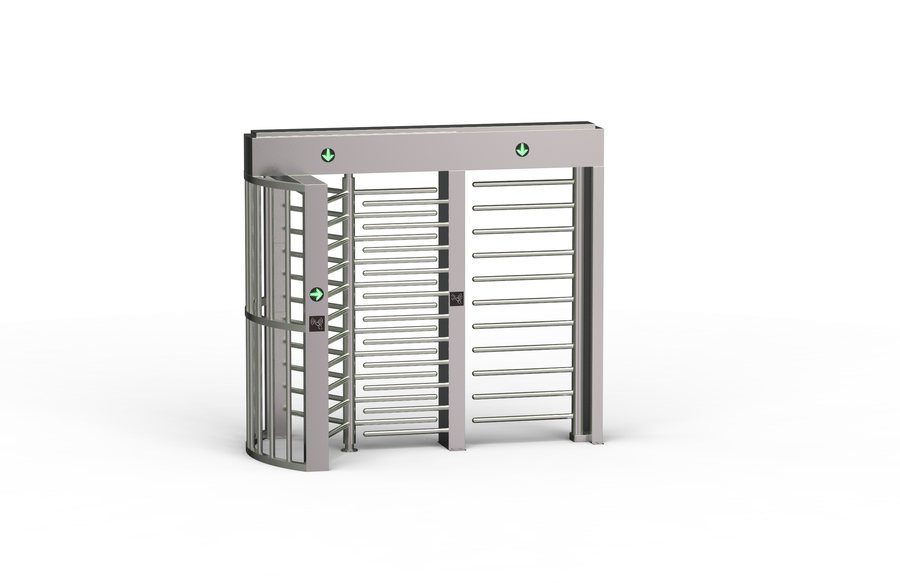
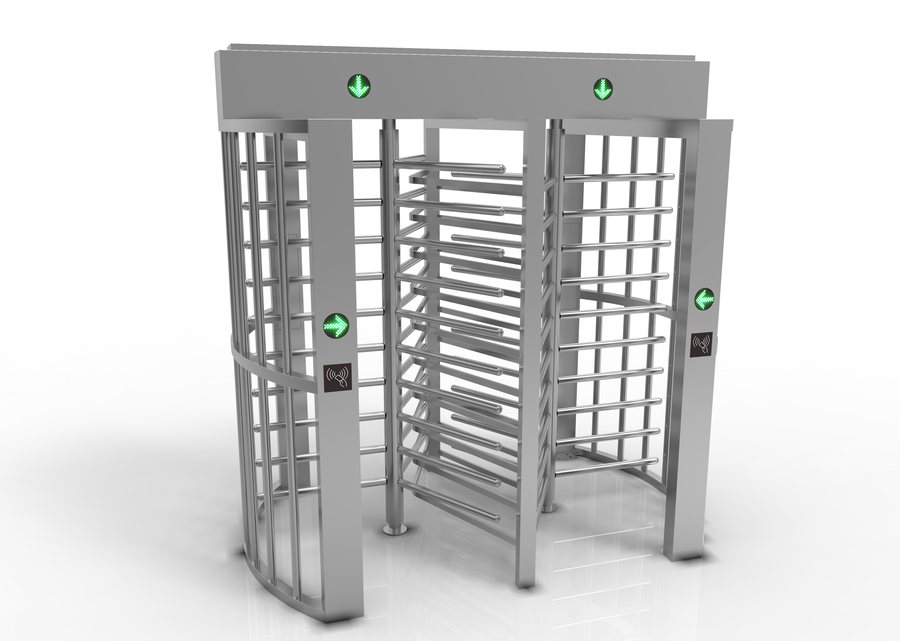
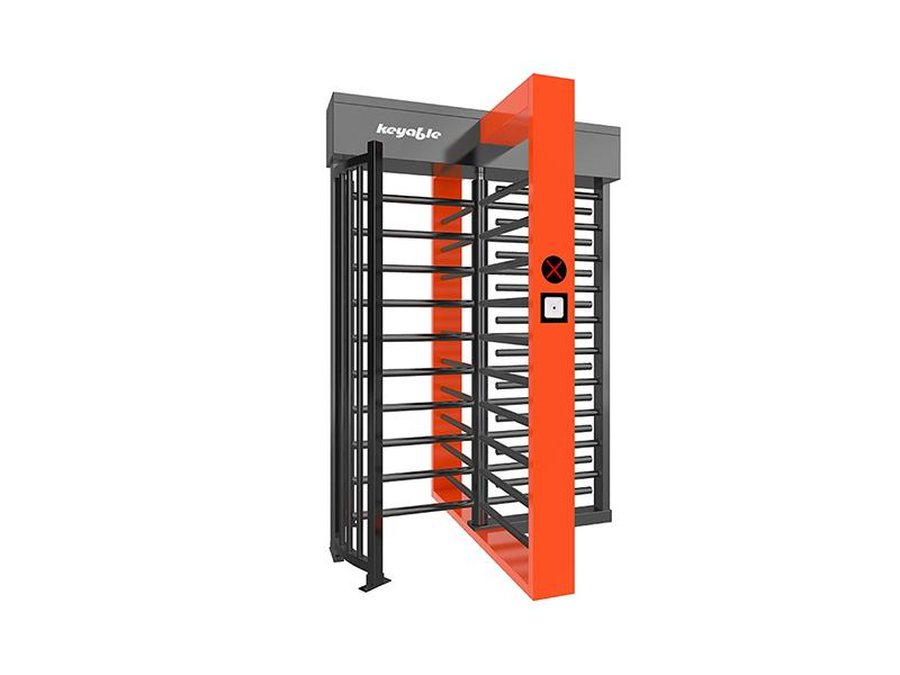
2300 mm, floor to canopy
There is no gap above the rotor and none below it. Every other barrier type asks a determined person not to climb; a full-height turnstile removes the option entirely, which is why it holds perimeters rather than lobbies.
Where the barrier has to be the wall. A floor-to-ceiling rotor that cannot be climbed, crawled under or reached over — for perimeters that are unstaffed, unlit and unsupervised.
Press Pass through to index the rotor by 120° — one passage, floor to ceiling.
There is no gap above the rotor and none below it. Every other barrier type asks a determined person not to climb; a full-height turnstile removes the option entirely, which is why it holds perimeters rather than lobbies.
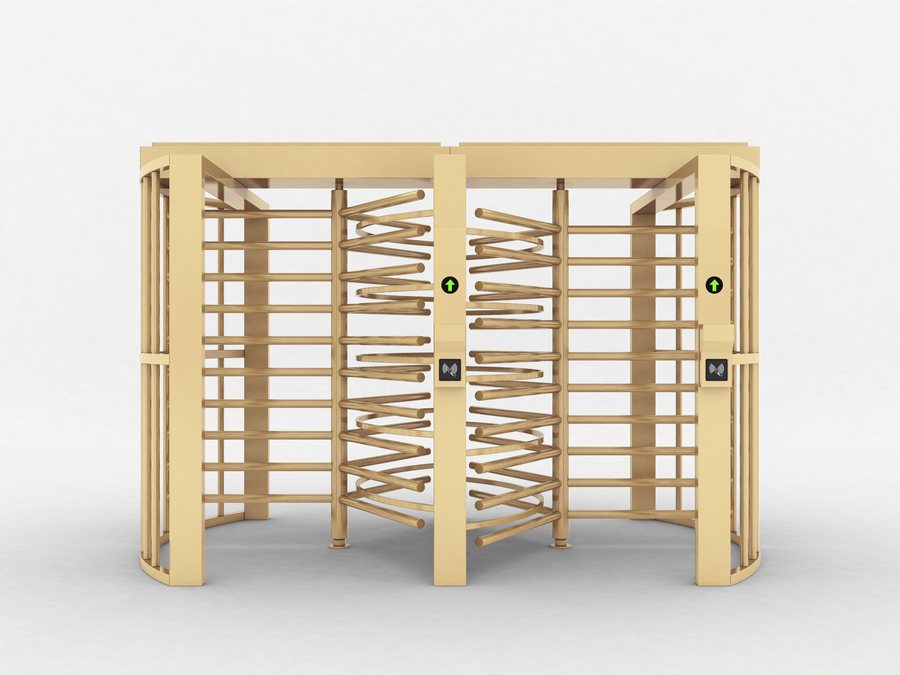
Three rotor sections divide the drum into compartments of 650 mm. Two people cannot share one; the geometry does not permit it, with or without a sensor watching. Rotation is offered at 90° or 120° depending on how the site prefers to meter flow.
A semi-automatic magnet drive releases the rotor on authorisation and a hydraulic buffer brings it to rest. The result is a rotor that turns under its own hand pressure but never slams — important on a mechanism this heavy and this exposed.
On power loss or an alarm signal the rotor is released to turn freely in the exit direction, so the perimeter that could not be climbed can still be left. Bi-directional control means the same structure meters entry and never obstructs escape.
Shared electronics, readers and control across the family. What changes is the housing, the finish and the setting each one is built for. Technical figures as published by the manufacturer, March 2026; a model without figures has not had them published rather than estimated.


An unstaffed perimeter with ticketed entry, powder-coated for the weather and impossible to walk around.
Two lanes in one structure, shift attendance at the fence line, and free rotation the moment an alarm sounds.
A full height turnstile is a floor-to-ceiling rotating barrier, 2300 mm tall, enclosed within a rigid frame. Because there is no gap above or below the rotor, it cannot be climbed or crawled under.
The structure is 2300 mm tall with a compartment of 650 mm and arms of 600 mm. Footprints run from 1450 × 1450 mm for a single lane to 2500 × 1450 mm for a double.
A single unit carries one rotor and one lane. The double configurations carry two rotors in one structure sharing a central post, doubling capacity for roughly one and a half times the footprint.
Yes. On power loss or an alarm signal the rotor is released to turn freely in the exit direction, so a perimeter that cannot be climbed can still be left.
Every model in the range is available either as a supply-only order or as a complete installation. The choice is commercial, not technical — the hardware is identical.
You already have an integrator, an access platform and a programme. We deliver the equipment and the paperwork, and stay out of the way.
One point of responsibility from the site survey to the fifth year of service. You approve a design and take delivery of a working entrance.
Both models cover the full range: speed gates, swing, flap and sliding barriers, tripod and full height turnstiles. Scope, response times and warranty terms are set per project and confirmed in the quotation.